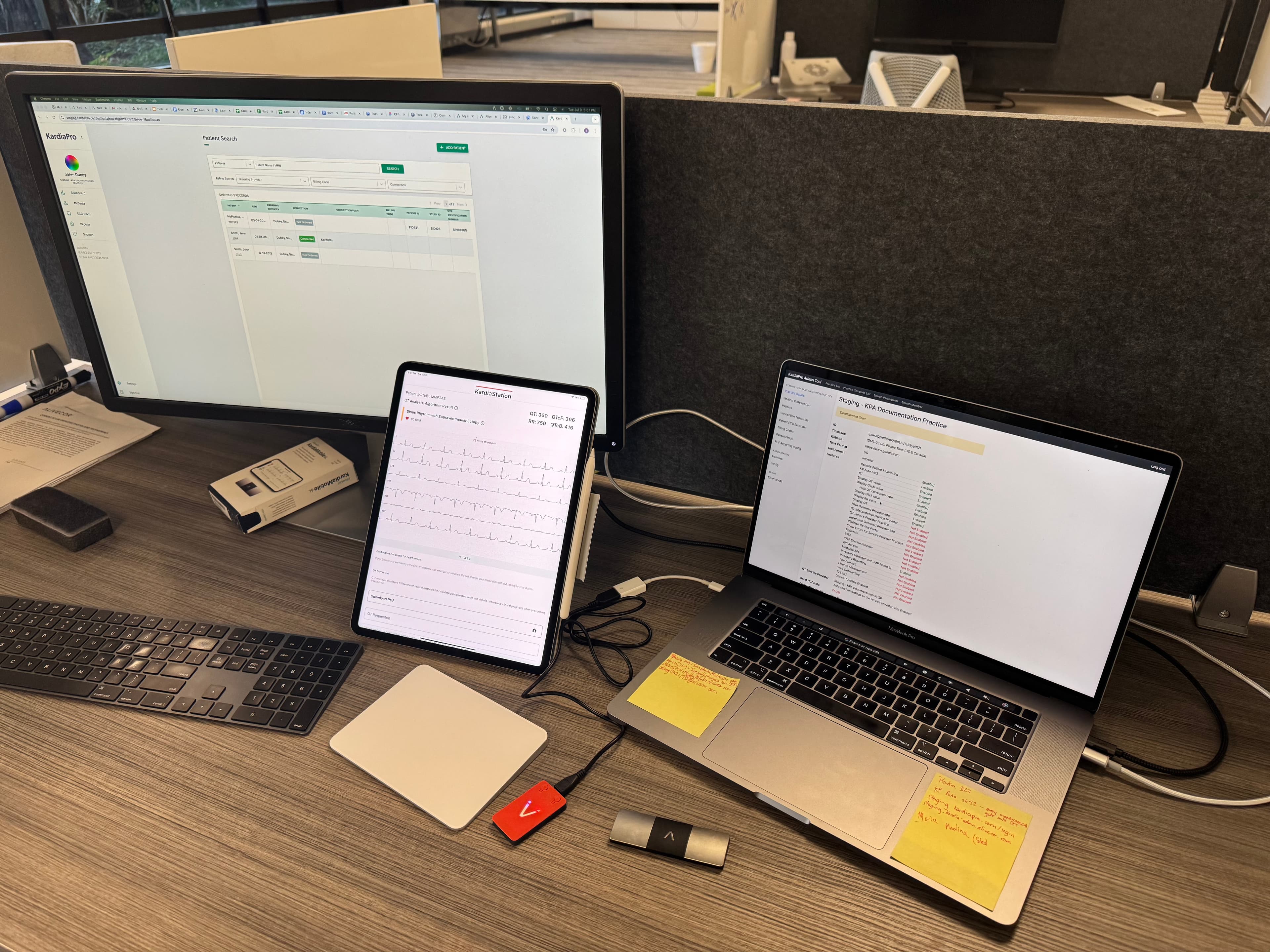
AliveCor Product Development
As Featured Intern at AliveCor, I mapped every setting interaction in the clinical platform through systematic testing, discovered hidden dependencies across the system, and designed self-service configuration flows that reduced setup complexity for clinical users.
Role
Product Development Intern (Featured Intern)
Duration
3 months (Summer 2024)
Timeline
2024
The Challenge
AliveCor's remote heart monitoring platform serves both direct patient care and clinical studies, but the clinical-facing configuration system had grown organically over years without proper documentation. Healthcare professionals struggled with settings that had hidden interdependencies, and the engineering team kept shipping features without edge-case testing. No one on the team had a complete map of how the system actually behaved. I was tasked with auditing the entire configuration system, documenting its real behavior, and redesigning the interface to simplify clinical onboarding.
Cross-functional Research
The configuration system touched every team, so I embedded with each one to understand their piece of the pipeline. With hardware engineers, I used Arduino boards to mimic ECG device signals for testing without clinical equipment. With the ML team, I learned how model outputs drove configuration requirements, specifically which settings affected data quality and which were cosmetic. With customer success and sales, I mapped real-world deployment contexts to understand which configurations clinical staff actually changed vs. which they left at defaults. This cross-functional mapping revealed where the system could be simplified.
The Stack
I used Figma for interface redesign and prototyping the simplified configuration flows, Jira for sprint planning, and Confluence for the system documentation I created from scratch. Arduino boards simulated device signals for testing edge cases without clinical hardware.
Hardware
- Arduino (device signal simulation)
- AliveCor ECG hardware (testing)
Software
- Figma (interface redesign, prototyping)
- Jira (sprint planning)
- Confluence (system documentation)
- Google Sheets (dependency mapping)
- Premiere Pro (handoff video walkthroughs)
Failure Log
The iterations and obstacles that shaped the final solution.
v1: Configuration Audit
Started by asking engineers to document settings, but their knowledge was fragmented and contradictory. No one had a complete map of how configurations interacted. I discovered 'ghost dependencies' where changing one setting silently affected others.
Switched to systematic manual testing. Created test scenarios for every setting combination, building the source of truth from scratch. This audit became the foundation for designing which configurations could be automated.
v2: Redesign Assumptions
Initial redesign assumed clinical staff understood the underlying system architecture. Figma prototype testing revealed they needed context-specific defaults, not a better-organized version of the same complexity.
Redesigned around deployment-context presets (patient monitoring vs. clinical trial) that pre-configure appropriate settings. The Figma prototype reduced required user decisions from 20+ to under 5 for standard deployments.
v3: Implementation Handoff
Delivered the complete audit, documentation, and Figma redesign on schedule, but engineering implementation was scheduled after the internship ended.
Created detailed handoff documentation and recorded video walkthroughs. Scheduled follow-up calls post-internship to support the engineering team during implementation.
D2C Strategy
Beyond the platform redesign, I conducted user research to inform direct-to-consumer strategy. Interviews revealed that monitoring loved ones' health was a top motivator for platform adoption, particularly for families managing chronic conditions. I synthesized these findings into a subscription tier strategy proposal and presented it at the company's internal pitch day. The proposal modeled a path to 50% D2C market penetration growth over two years based on the adoption patterns I identified in the research.
The Outcome
As Featured Intern, I delivered five artifacts: a complete configuration audit documenting every setting and its dependencies, a ghost dependency map that exposed bugs no one knew existed, a simplified Figma redesign of the clinical interface, comprehensive platform documentation (the first the team had), and a D2C strategy proposal with subscription tier modeling. The redesign and documentation were handed off to engineering for implementation after my internship. The most valuable skill I took away was learning to operate across hardware, ML, and UX teams simultaneously, translating between engineers who spoke in signal fidelity and clinicians who spoke in patient outcomes.